Page 8 of 8
Coltrane circle
John Coltrane drew his own version of the circle of fifths, by hand. It's widely reproduced, and people call it the Coltrane circle. Here it is.
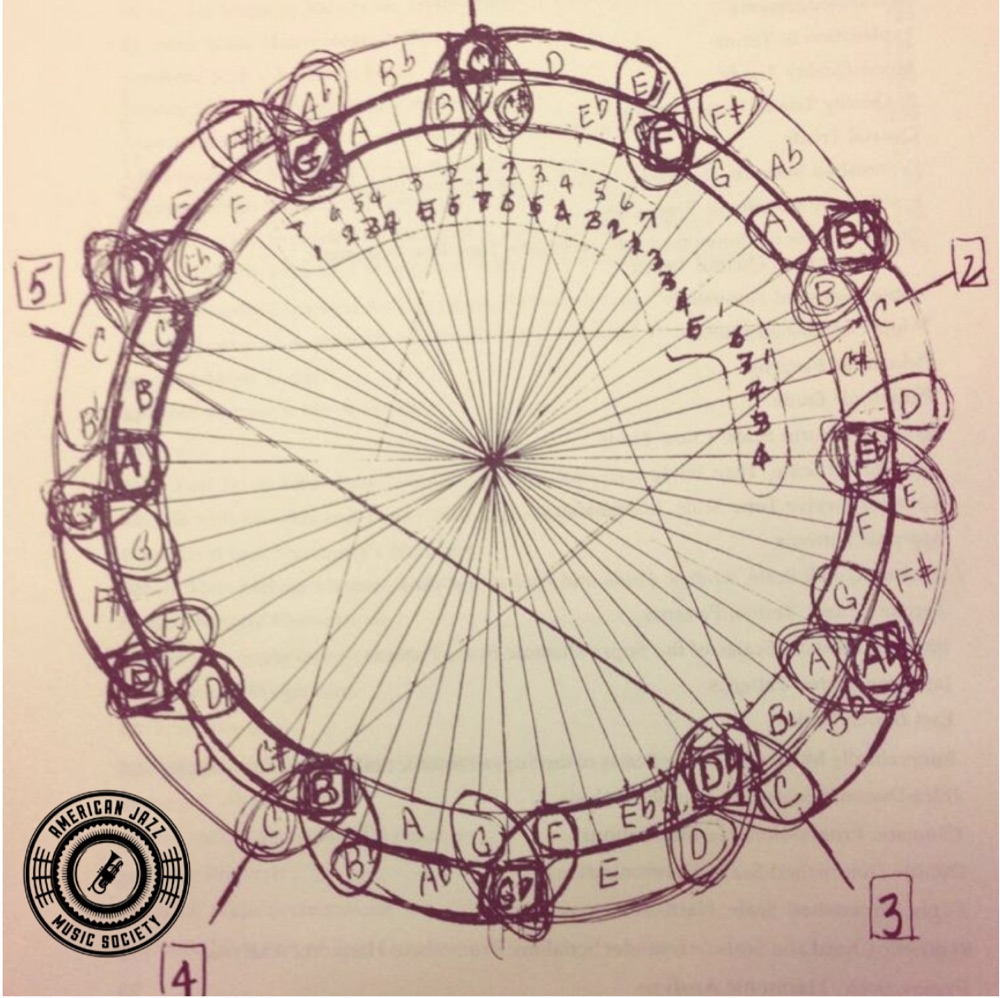
This is the drawing as it circulates, with the American Jazz Music Society's mark in the corner.
What you'll see: the twelve note names set around a ring. A second ring inside it. Some notes boxed or circled. Lines running through the middle. Small numbers, 1 to 5, in the margin. Nobody should pretend to give the one true reading of what he meant, and I won't.
What I can tell you is why a player would draw the wheel this way. It's full of patterns, and they're exact.
Seven neighbours in a row, F C G D A E B, are the seven notes of a major scale. Five neighbours in a row, C G D A E, are the five notes of the major pentatonic scale. Take every second position around the ring and you get six notes of a whole-tone scale: C D E F♯ G♯ A♯. The other six notes make the other whole-tone scale. Take every third position and you get the four notes of a diminished seventh chord: C E♭ F♯ A.
Same wheel as the one in this chapter. Read it for key signatures and it's a compass. Read it for patterns and it's a map of shapes. That's the whole idea.