Page 2 of 8
What a scale is
A scale is a recipe of steps that starts on a home note, the tonic, the lowest note of the scale. Intervals gave you distances; a scale lines a few of them up in a fixed order and turns them into a sound. Change the tonic and the recipe stays. That's the whole idea.
Major
Major is the one everybody knows, the "do re mi" scale. Whole, whole, half, whole, whole, whole, half: W-W-H-W-W-W-H. A half step is the next piano key, black keys included; a whole step is two. Seven steps, and the last one lands back on the tonic, an octave up.
W and H look like code? They're not: interval notation and jargon explains them.
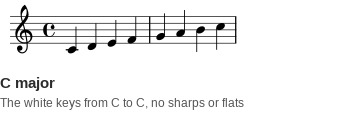
Build it from C and you never touch a black key: W to D, W to E, H to F, and so forth, and you land on C D E F G A B C.
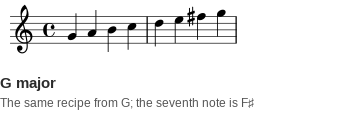
Now start on G with the same recipe. Everything fits until the seventh note: the recipe wants a half step below G, and the white key F is a whole step away. So a black key joins the scale, and it's spelled F♯, not G♭, because a scale uses each letter once and G is already home. scales jargon has the rule. Different tonic, same skeleton, one sharp.
Time to work
Two checks: count the half steps against the recipe, then read the letters: seven notes, seven letters, none twice. G A B C D E F♯ passes. G A B C D E G♭ fails: two Gs, no F.
Don't stop at C and G. Build all twelve majors in the exercise below, one tonic at a time. Each finished scale stays on a shelf under the exercise, so by the end you have all twelve in front of you.
To see any scale, use the player on Scales.
W – W – H – W – W – W – H
Turn your sound on. The notes play when you press Play.
Interactive on the web: Exercise: major scales. Pick a tonic, tap the keys of the scale and watch the staff fill in; Play lets you hear it; finished scales stay on the shelf.
Sharp or flat?
Finish a scale in the exercise and some notes wear a ♯ or a ♭. Which one isn't a matter of taste. A scale uses each letter from A to G once, in order. Call the seventh note of G major G♭ and you've got two Gs and no F, so it's F♯.
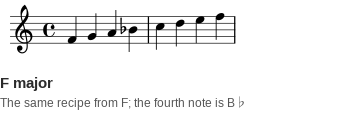
That's why a key signature is all sharps or all flats, never a mix. G major has one sharp: F♯. F major has one flat, its fourth note: B♭, not A♯, because the letters must run F G A B C D E.
Keys a fifth up from C (G, D, A, E, B) collect sharps; keys a fourth up (F, B♭, E♭, A♭) collect flats. Some tonics on a black key have two names. D♭ major and C♯ major sound the same, and the usual pick is the one with fewer accidentals: D♭ (five flats) beats C♯ (seven sharps). F♯ major (six sharps) and G♭ major (six flats) are tied, so both are in use. A later chapter shows why the sharp keys arrive in the order they do.
Natural minor is next: natural minor scale.